Hey,
I recently had dinner with a friend of mine who happens to be the VP Chief of Staff for one of Canada’s biggest retailers. Over a pile of saucy meatballs, we got candid about how much of our jobs are now dedicated to managing AI agents, and how that’s made us use it as little as possible outside of work.
I know a lot of folks are in our boat. So grab a paddle, pal.
Getting picky about how much I use AI made me picky about who I listen to about it. AI thought leaders tend to fall into one of two camps: the totally unhinged tech bros deep in AI psychosis, and the anti-AI activists who focus on the apocalyptic side effects of it.
I managed to train myself to turn the tech bro echo chamber into white noise (highly recommend). Many anti-AI activists are doing important work to highlight the consequences of using AI, but when you work in a field that requires you to use those tools in order to stay employed, consuming so much of this content can put you in a constant state of guilt and existential dread.
When I started getting intentional about where I was getting my information from, I found the researchers and thought leaders who approach AI from a grounded lens that keeps me informed without the dread. The voices I’ve found most useful are, overwhelmingly, women.
Shae O. Omonijo is a public educator, historian, and PhD candidate whose newsletter, AI, the Humanities, and the Future of Work, is an essential, fascinating read. In her recent work, she introduced me to a term I haven’t stopped thinking about: Algorithmic Agnotology.
Agnotology is the study of ignorance and confusion that’s created on purpose. Algorithmic agnotology, a term coined by Alondra Nelson, is what happens when AI companies do it. They explain their products in ways that sound transparent but are too complicated for most people to follow. That keeps the public from asking questions, lawmakers from regulating, and the companies from being held accountable.
If that sounds like a marketing strategy, that’s because it is, albeit a supervillainous one. Many of the consumer protection and advertising laws we have today exist because of agnotological marketing of yore.
Before there was Big Tech, there was Big Tobacco. Almost everyone smoked in the mid-century, but by the late 60s, scientists and health officials were warning the public about the health risks of smoking.
These companies saw that as a threat and started marketing aggressively to convince the public that the science was too uncertain to trust. In 1969, an industry document from Brown and Williamson tobacco company explicitly stated “doubt is our product.” *shivers*
That’s agnotology, baby.
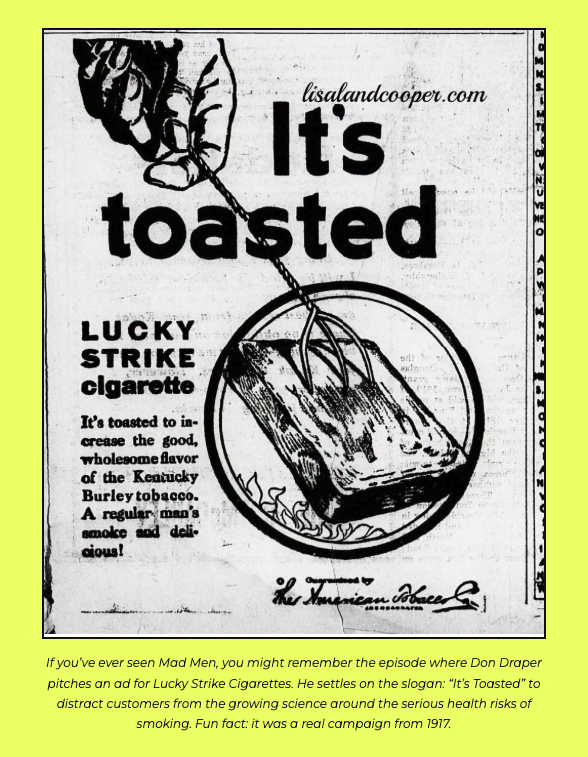
Big Tobacco knew their product was addictive and harmful, but their survival became more important than their customers’ safety. This is what Alondra Nelson is asking us to think about in relation to AI companies. For a deeper dive, her speech at the International Association for Safe & Ethical AI conference earlier this year is a must-watch.
This is so relevant for marketers because it connects to many of the frustrations I’ve heard (and experienced firsthand) about using AI. These tools are complex, their use cases are broad and tied to your role, and they’re increasingly mandatory at work. At the same time, employers rarely hand over formal training for your specific role, because the assumption is that you already know how to use these tools. That leaves folks to find training on their own.
That was the case for me. I tried my darndest to wing it but quickly figured out that the most time and cost effective way to grow my confidence with AI, and operate at the velocity that’s now expected, was to get marketing specific AI training.
Growclass’s AI instructors, Tiff and Joelle, are two more women making sense of AI for the rest of us.
The most abundantly available content around AI doesn’t ask us to think critically. Step outside of those options, and you’ll find expert voices in AI who want to teach you something new, to think differently, to exercise better judgment, and become a more creative thinker.
An informed marketer makes it a whole lot easier to be an ethical marketer. It helps you understand what’s really going on below the surface, what to look out for, and what not to do.
That’s what developing those marketing chops is all about.
Until next time,
Ines
If you found this useful, please be a helpful work friend and send it to a colleague, or share it on Slack. Did a friend forward this newsletter to you? You can subscribe here.
Expert-led workshops on copywriting, SEO and everything in-between. Hands-on seminars to build a career you love. Skills and templates you can put to work right away while connecting with excellent humans. Oh, and sometimes we make scones.