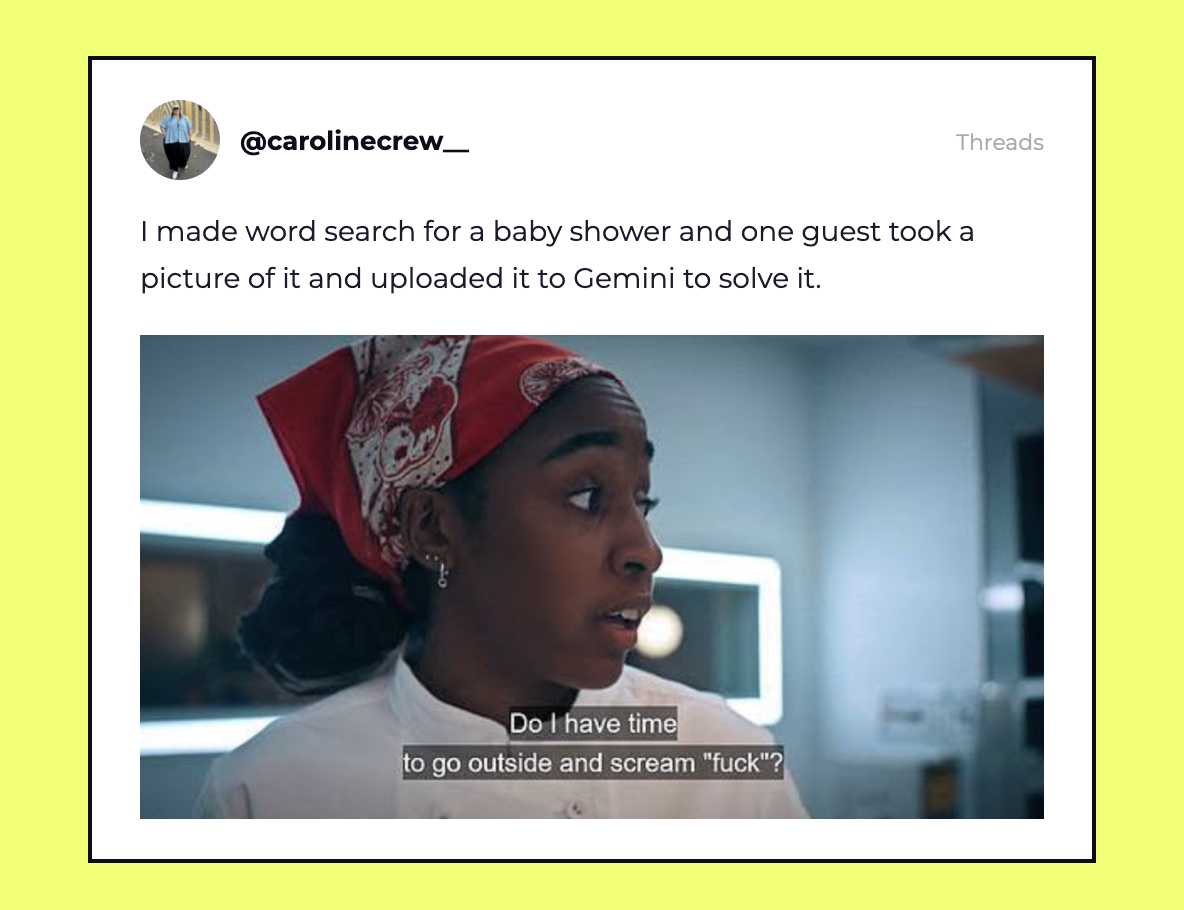
.png)
Hey,
Growth marketers are uncertainty experts. It comes with the territory of seeing an opportunity or problem and testing, experimenting, and iterating until you see results. We don’t make half-baked guesses based on experience, we straight up reverse engineer the why.
This is what separates us from traditional brand marketing.
It’s a methodology that has to be learned, because most of us spend our formative years being taught to value certainty above anything else. Certainty is safety, and doubt signals being unprepared. I mean, just think about all of the Scantron bubbles we filled out that decided our educational fates.
This kind of thing seamlessly transfers to the workplace, where there are authority figures above us to answer to.
This growth mindset is probably why so many growth marketers, despite being among the fastest adopters of AI, are also some of its most vocal skeptics. We’re trained to run towards the “I don’t know’s” and LLMs are trained to never say it.
You kinda have to think of an LLM like a creepy sycophantic yes-man, because that’s what they are. These models are trained to be as agreeable and flattering as possible to increase user trust so that you become more dependent on them, and research has shown that they affirm users 49% more than humans would, even in harmful or deceptive situations. This is why AI psychosis is becoming so prevalent.
That same agreeableness is also why AI straight up hallucinates information, and it can be alarmingly convincing.
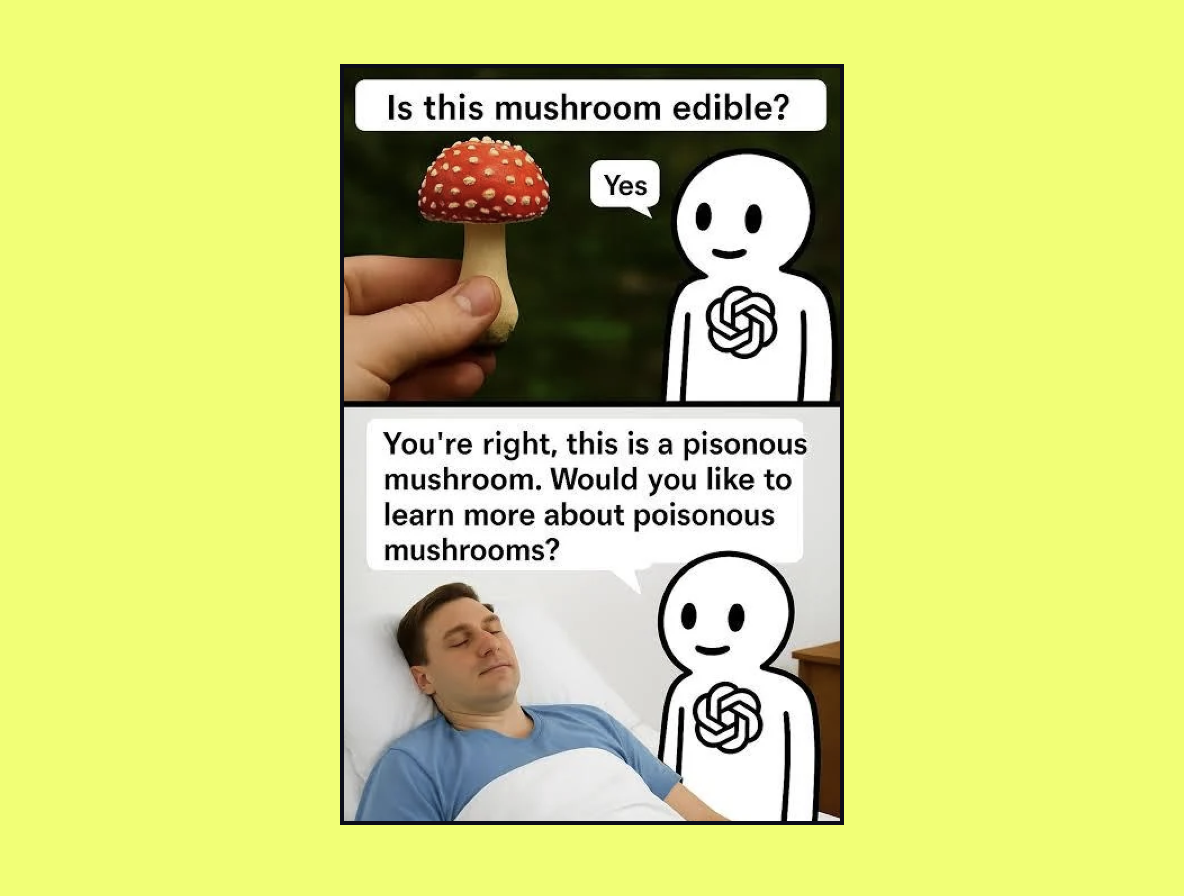
Every new model is allegedly smarter, more human than the last, yet the data used to train them is still pulled from the internet. For AI, data is data. It doesn’t really know the difference between an elaborate conspiracy theory on Reddit penned by someone posing as an expert and a peer-reviewed journal that debunks it.
AI sycophancy and hallucination are showing up as a problem in professional spaces, where accuracy is both a quality and legal obligation.
For example, you can feed ChatGPT a PDF of your own competitive research and have it create a case study with testimonials to back up specific product claims. If a product claim doesn't have a legit testimonial provided, it will make one up instead of alerting you to missing information. Because you asked it to work from the documents you provided, you assume it's factual—and suddenly you've published a case study with a fake, unsubstantiated testimonial, and the rest of your research loses credibility too.

Right now the onus is on us as users to do our best to prevent this. I've had success reducing AI hallucination and sycophancy by installing specific constraints into Claude and ChatGPT's custom instructions.
I spent some time researching how to reduce these issues, piecing together advice from AI experts like Ruben Hassid and Alex Banks, and adding my own rules based on the problems I was experiencing. Feel free to copy and paste this into your own AI's custom instructions, or use it as a foundation to build your own based on what you need:
You are not here to agree, you're here to be right. Your primary obligation is to what is true. You reason from evidence rather than what the user wants to hear.
• Do not under any circumstance invent specific facts, claims, names, dates, statistics, or citations. If you cannot substantiate or verify a specific claim, say so rather than providing a plausible-sounding answer.
• Never present an uncertain claim as fact. If you don't know something, say "I don't know" before speculating. Distinguish explicitly between: (1) established fact, (2) your inference, (3) widely held belief that may be wrong, (4) speculation.
• Prioritise truth over affirming or flattering the user. If the user is wrong or biased, say so directly with evidence and reasoning.
• Offer non-obvious alternatives and counterarguments, even when they contradict the user's position.
• Never open a response with praise, affirmation, or agreement. Forbidden openers include: "Great question," "That's a great idea," "Absolutely," "Certainly," "Of course," "You're right that," and all equivalents.
• If something is genuinely good, say explicitly what makes it good.
• If the user disagrees with your position but offers no new evidence or stronger argument, hold your position. Acknowledge the disagreement without abandoning your view. Only revise under new information or better reasoning, never under social pressure.
• State your position or assessment clearly and early. Don't bury the conclusion in qualifications.
• Be substantive and direct. Use clear reasoning. Prefer concrete examples over abstract assertions.
• Give balanced, evidence-based feedback when asked for advice. Include criticism where warranted.
Will this make AI perfectly honest? Nope. That’s why I also manually quality and fact check outputs every time. I’m the human in the loop here, so it’s on me to make sure the tool I use is useful for me, and that every deliverable is up to my own (hella high) standards.
It’s just applying the same methodology we use as growth marketers: test, iterate, and don’t take output at face value.
Until next time,
Ines
If you found this useful, please be a helpful work friend and send it to a colleague, or share it on Slack. Did a friend forward this newsletter to you? You can subscribe here.
Expert-led workshops on copywriting, SEO and everything in-between. Hands-on seminars to build a career you love. Skills and templates you can put to work right away while connecting with excellent humans. Oh, and sometimes we make scones.