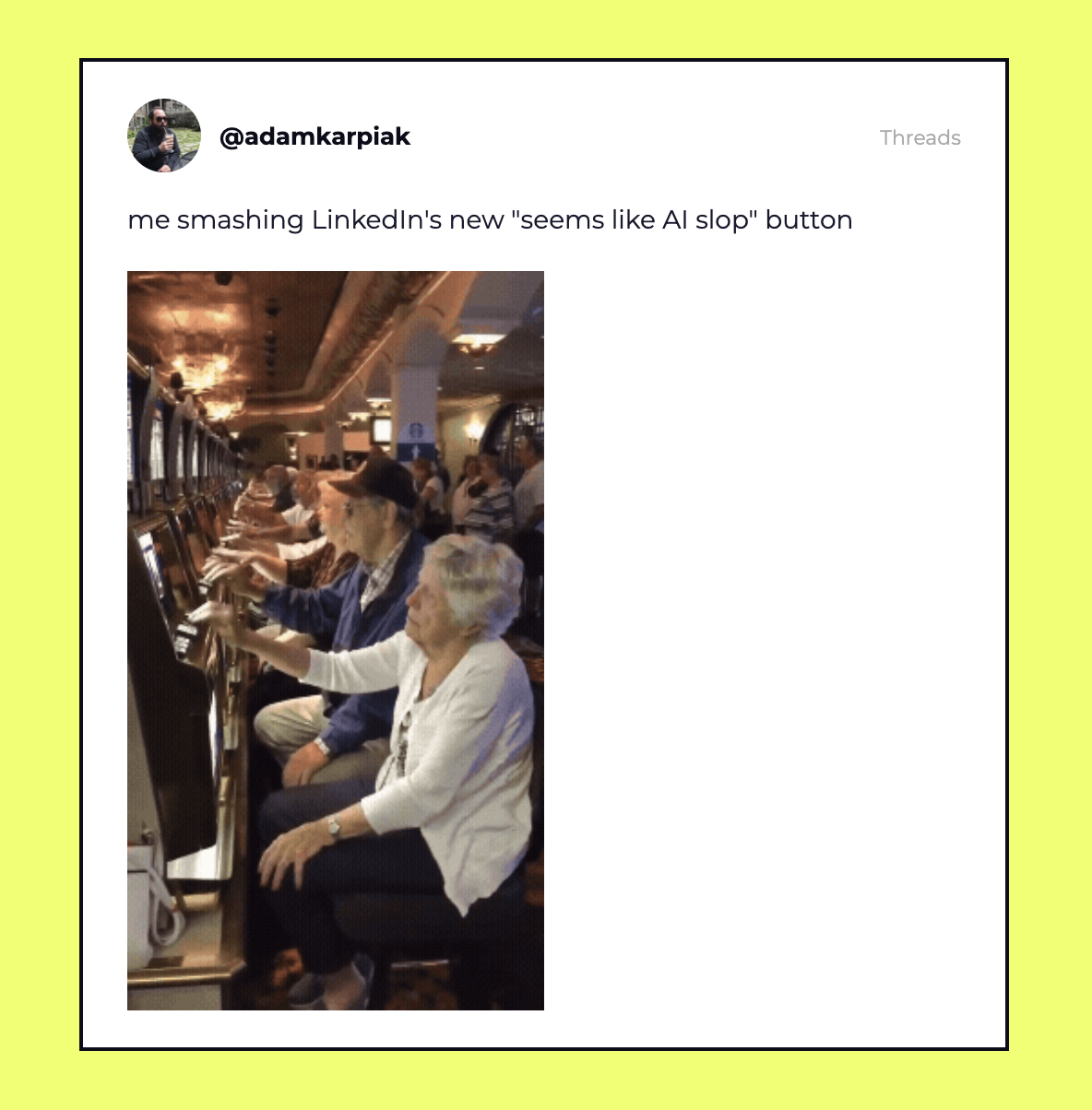
.png)
Hey,
No seasoned marketer or copywriter wants to hear this question—ever.
That's because it isn't really a question. It’s an accusation disguised as one, and we're hearing it more and more in client reviews, in performance feedback, and from managers who suspect something's off and can't quite put their fingers on why.
We’re wading through many confusing contradictions. There’s pressure to adopt AI, rarely with any proper training or governance around how. Pair that with the AI slop cluttering our feeds and the mass distrust it’s created, and it’s really no surprise that we’re all turning into prosecutors.
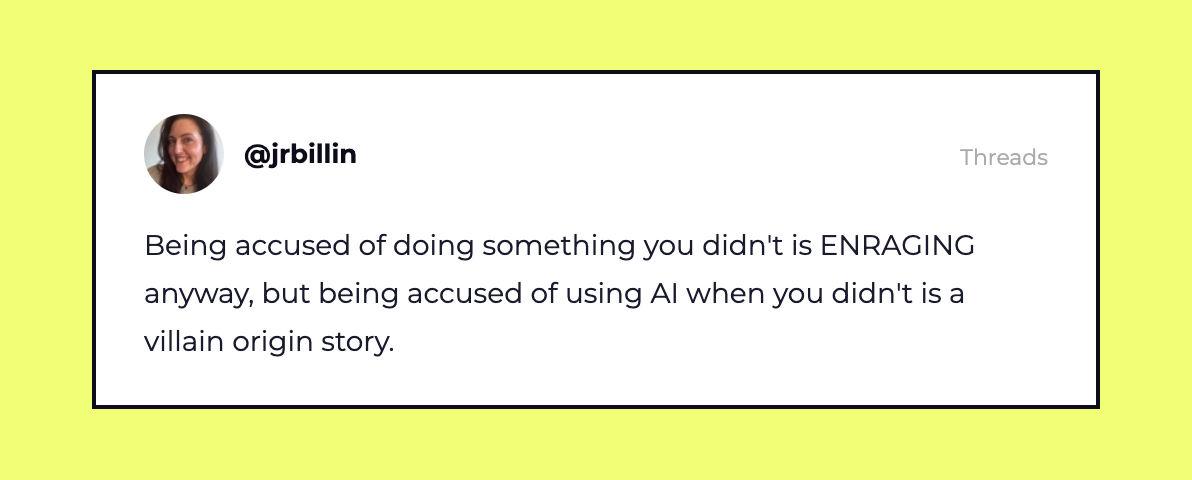
Being accused of doing something you didn't is ENRAGING anyway, but being accused of using AI when you didn't is a villain origin story.
What’s so sucky about it is that it doesn’t actually matter whether you used AI. What matters is whether someone believes you did.
You can’t argue yourself out of someone else’s perception. If they’ve already accused you, they’ve already decided they’re right.
I'll give some mercy to those who've confronted someone on this, because nobody really wants to ask a colleague if they cheated on their homework. Most of the time, they're just doing their job to protect quality. But some organizations want more than a hunch and turn to AI detectors.
It seems like a no-brainer. You run content through a tool, get a score, prove (or disprove) humanity, and move on.
Except one liiiiitttle problem: AI detectors suck.
They’ve always been unreliable, and companies that sell them have a tendency to significantly understate how inaccurate they can be. Let’s look at the facts:
• A 2023 Stanford study showed that 97% of essays that were written by ESL writers were flagged by at least one AI detector.
• Even in 2026, dozens of universities across the world have banned AI detection software due to unreliability and bias.
• AI detectors today disproportionately flag content written by neurodivergent writers.
You’d think that companies would heed the warnings, but in July, Substack announced their partnership with Pangram, an AI-powered AI detection tool:
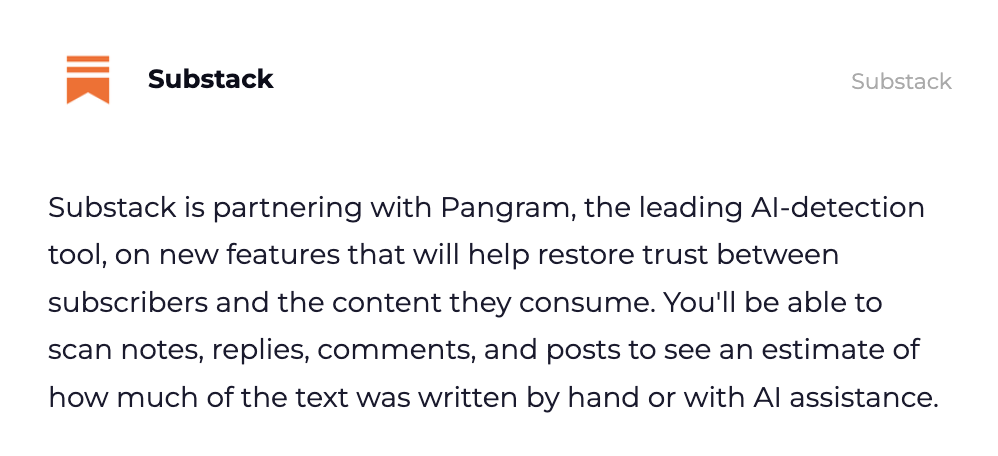
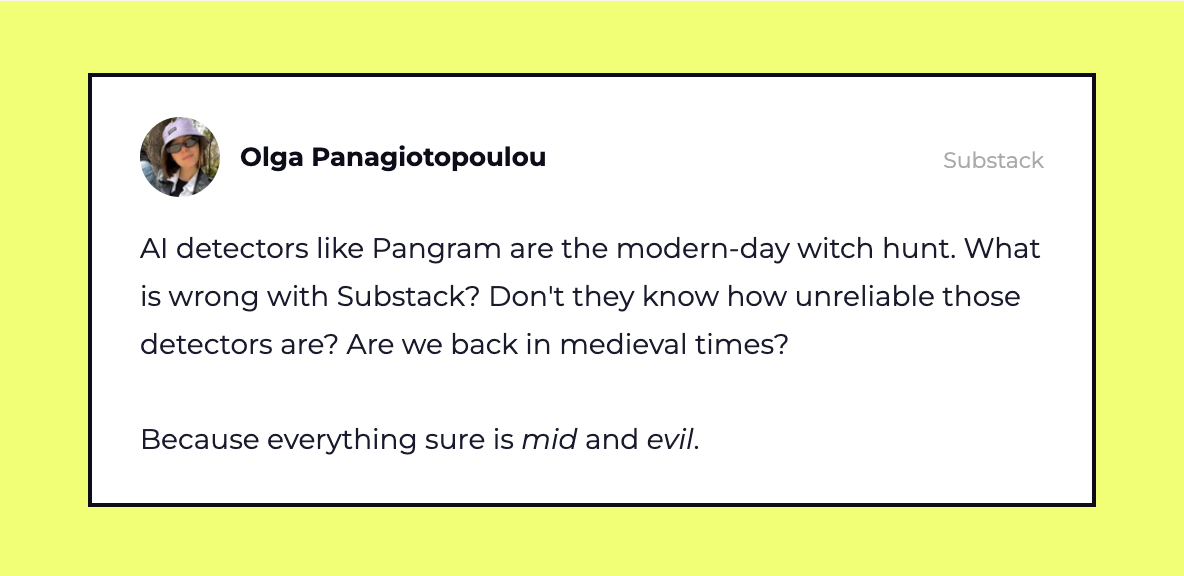
The rollout also includes an optional AI author’s note that writers can add onto their work to disclose their use of AI. It’s a reasonable idea in theory, but the detection feature is not. Within hours after the announcement, writers on the platform protested, calling it a witch hunt.
Oh right, it’s data. When your content gets scanned, you're also handing over your intellectual property to a company that trains AI models. It's not so much a helpful tool as it is a theft pipeline with snazzy branding. Sounds criminal, but it's somehow not.
At some point, governments will have to stop treating AI companies like a solid gold ball-and-chain and start regulating them. The EU has decided to take the lead on this one, because of course they have. Coincidentally, as of today AI transparency laws go into effect, making labelling AI generated output legally enforceable.
Some companies like Google have preemptively addressed these laws by inserting invisible digital watermarks on Gemini output that stays intact even when copied, reformatted, or otherwise altered.
This becoming standard practice would be a big win for the folks who've spent years being bro-badgered into believing their jobs will be replaced.
Future AI provenance is great, but it doesn’t really help the marketers who are being accused of using AI now.
If you’re a freelancer without an AI transparency policy built into your contracts, or a marketer at a company that hasn't built one, consider putting one together that covers:
• What AI tools you use (and don't)
• How you use them, and how you never use them
• How you protect proprietary data from AI training sets
• How you guarantee accuracy and quality
• How you ensure deliverables are original and copyrightable
The accusations aren’t going to stop anytime soon. The best thing anyone can do is show up with receipts.
Until next time,
Ines
P.S. We hope you like our new look 😉
If you found this useful, please be a helpful work friend and send it to a colleague, or share it on Slack. Did a friend forward this newsletter to you? You can subscribe here.
Expert-led workshops on copywriting, SEO and everything in-between. Hands-on seminars to build a career you love. Skills and templates you can put to work right away while connecting with excellent humans. Oh, and sometimes we make scones.